ReJUST
The ReJUST project was funded by the US Environmental Protection Agency STAR program and involved team science collaboration to address the priorities and preferences of a partner community.
The project developed a comprehensive study to examine local energy services needs and energy burdens, understand economic impacts and public health concerns associated with a local energy generation facility, and identify preferences for energy transitions that support decarbonization, energy access, economic opportunity, and community wellbeing.
The goal of this project was to inform regional-scale energy transitions in forest-dependent rural communities and Tribal Nations. The team aimed to identify pathways that maintain or enhance economic opportunities and improve air quality in the context of community priorities and the urgency of addressing climate change.
The project used an interdisciplinary approach to analyze impacts of current energy systems and identify pathways for energy transitions that can enhance well-being through improved public health, economic opportunity, and energy justice outcomes. The project began in July 2023 and was intended to run through June 2027 but was terminated by federal action in May 2025.
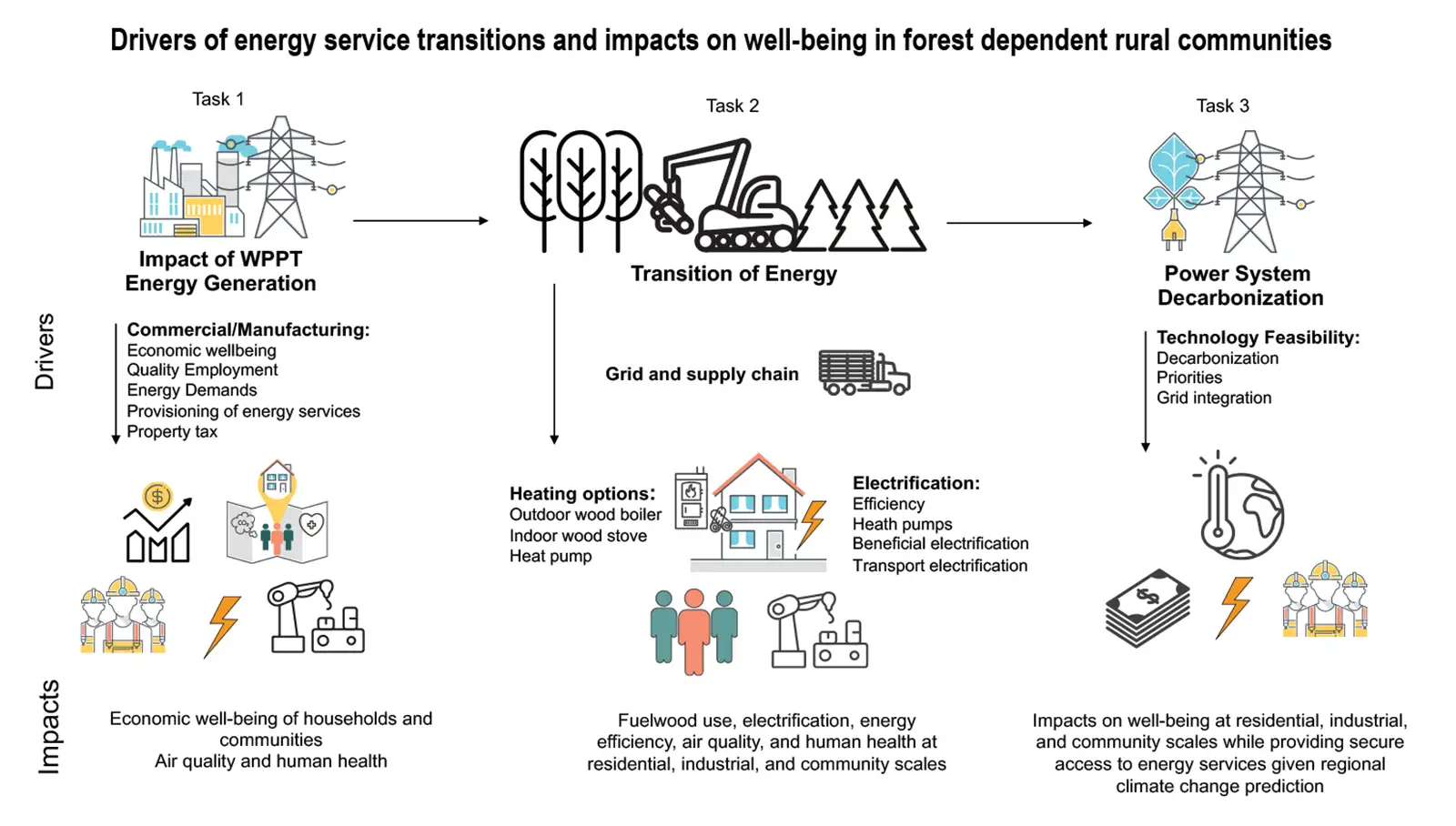
This figure is titled Drivers of Energy Service Transitions and Impacts on Well-Being in Forest Dependent Rural Communities.
Task 1: Impact of WPPT Energy Generation
Drivers
Commercial/Manufacturing:
- Economic wellbeing
- Quality Employment
- Energy Demands
- Provisioning of energy services
- Property tax
Impacts
- Economic well-being of households and communities
- Air quality and human health
Task 2: Transition of Energy
Drivers
- Grid and supply chain
- Heating options:
- Outdoor wood boiler, Indoor wood stove, Heat pump
- Electrification:
- Efficiency, Heat pumps, Beneficial electrification, Transport electrification
Impacts
Fuelwood use, electrification, energy efficiency, air quality, and human health at residential, industrial, and community scales.
Task 3: Power System Decarbonization
Drivers
Technology Feasibility:
- Decarbonization
- Priorities
- Grid integration
Impacts
Impacts on well-being at residential, industrial, and community scales while providing secure access to energy services given regional climate change prediction.