The Food – Energy – Water Consciousness (FEWCON) Study of Household Consumption
The FEWCON project sought to identify opportunities to reduce greenhouse gas emissions through conservation of household-scale direct and indirect energy usage, with a focus on food and water emissions.
The FEWCON project sought to identify opportunities to reduce greenhouse gas emissions through conservation of household-scale direct and indirect energy usage. The focal point being on food and water emissions.
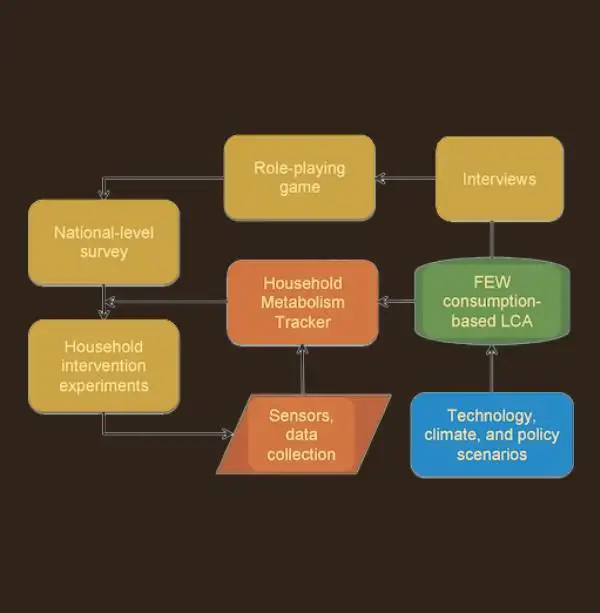
Starting in fall of 2016, a large team of collaborators was funded on a 5-year National Science Foundation Innovations at the Nexus of Food, Energy, and Water (NSF INFEWS) “Reducing Household Food, Energy, and Water Consumption: A Quantitative Analysis of Interventions and Impacts of Conservation” program project.
The project involved an ambitious blend of:
- Modeling current and future potential scenarios in food, energy, and water consumption conducted by a team of engineering scientists
- An iterative feedback between social science research, including role playing scenarios, surveys, interviews, and a household intervention study, to inform and refine that model
- Development of an innovative “household metabolism tracker” by a team of computer scientists used to track consumption and communicate impacts via the household intervention study
The project was expanded during the global COVID-19 pandemic to consider the intersections of public health perceptions and behaviors with climate change perceptions and responses.